
FRANCISCO JAVIER SÁENZ DE OIZA’S TORRES BLANCAS
ARCHITECTURE
A RETROSPECTIVE AT MADRID’S MUSEO ICO CELEBRATES THE ICONOCLASM OF SPANISH ARCHITECT FRANCISCO JAVIER SÁENZ DE OIZA (1918 – 2000), RETURNING ATTENTION TO HIS 1960S MASTERPIECE OF SPANISH ORGANICISM, THE TORRES BLANCAS.
Navarra-born, Francisco Javier Sáenz De Oiza is regarded as one of the most prolific Spanish architects of the twentieth century. In the 1950s, following an unimaginative return to the neo-classical style under Generalissimo Franco, Oiza, with peers Francisco de Asis Cabrero, and Miguel Fisac, began integrating international architectural vernaculars in their search for a Spanish Modernism.
Oiza, who spoke of being, “born in the middle-ages and living in the avant-garde of the twentieth century”, initially practiced a rational geometric modernism before moving towards a rebellious organicism style exemplified in his social housing projects in Madrid. The Spanish Modern Movement that consolidated itself sprung from this contradiction; embracing a true modern architecture and simultaneously participating in an exaggerated organic revisionism. This was a style that sought to reconcile human-built structures with nature, the precision of Mies van der Rohe in communion with the naturalness of Frank Lloyd Wright.
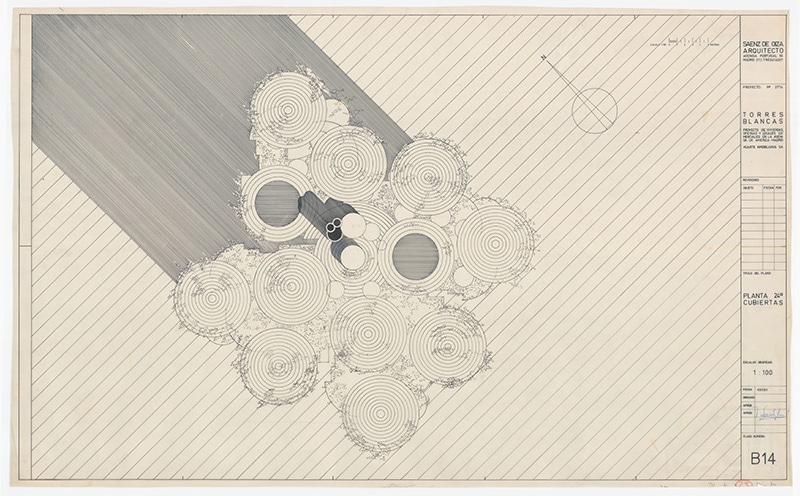
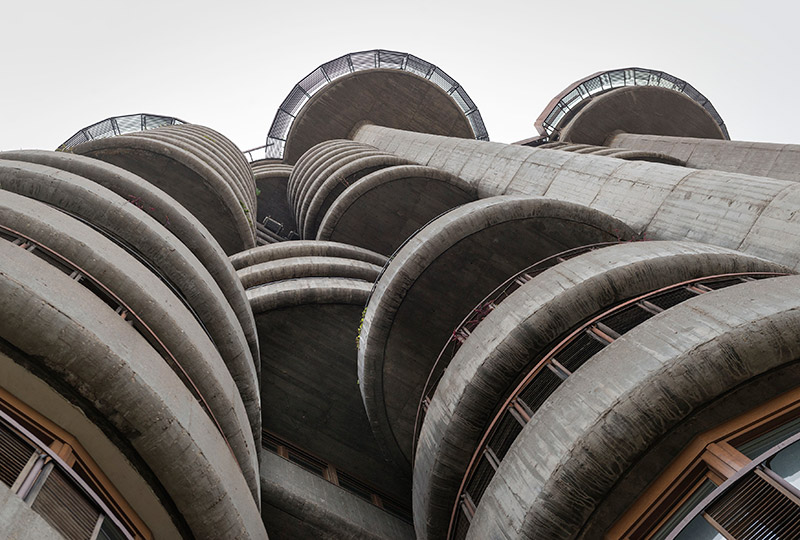
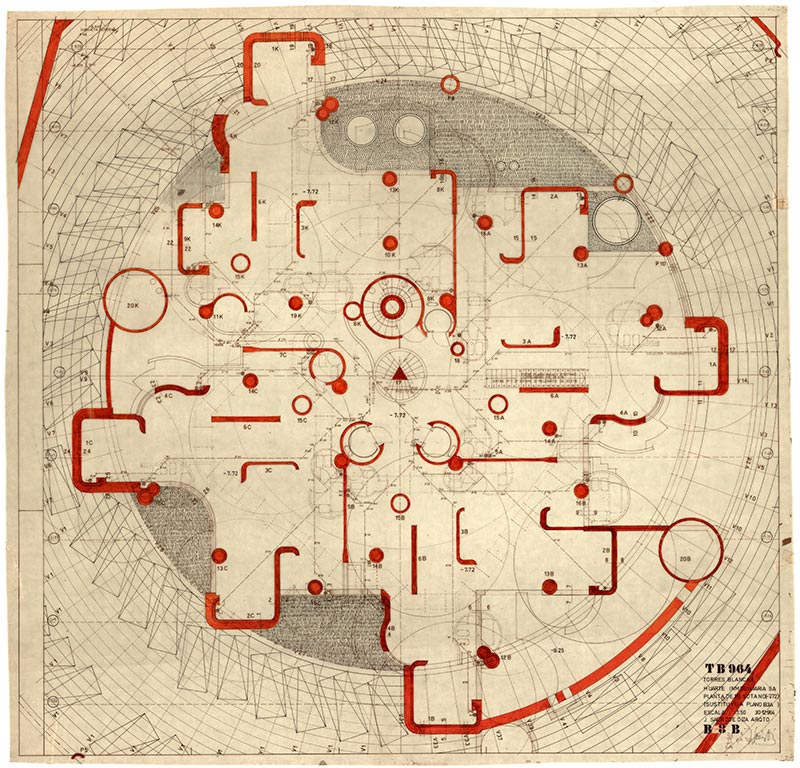
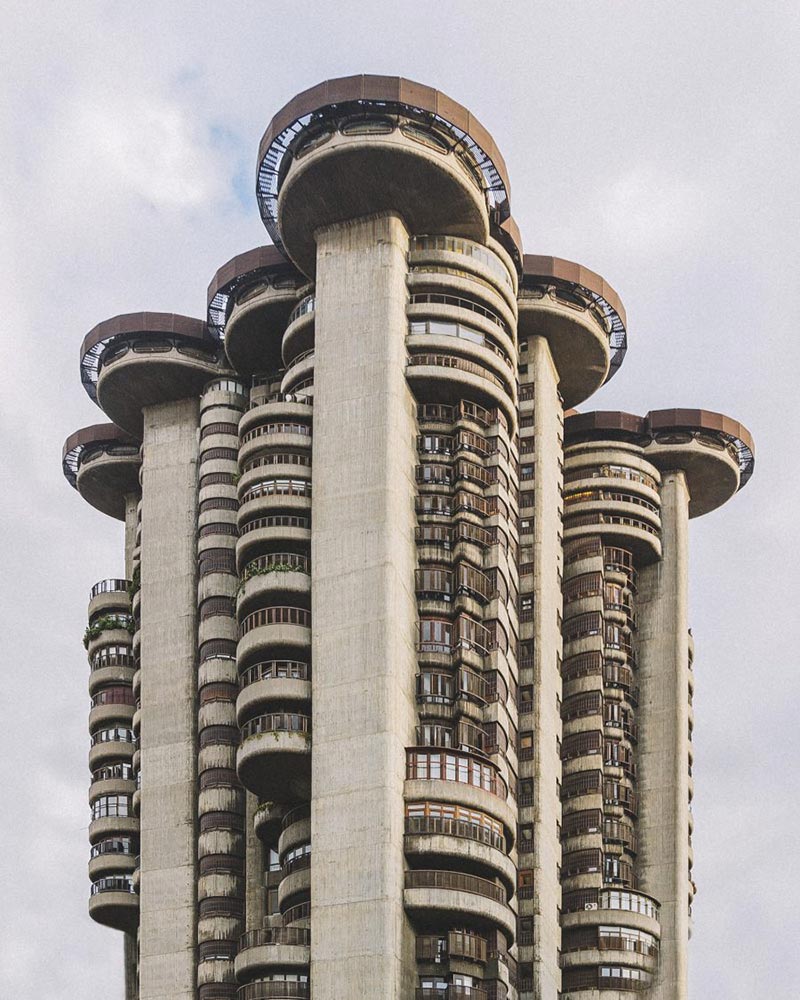
The contradictions of the movement, as well Oiza’s singular syncretic talent, is exemplified by his Torres Blancas urban housing project commissioned by John Huarte in 1961 and completed in 1969. “Torres Blancas is a communion of the prairie homes of Frank Lloyd Wright, the Kingo Houses of Jørn Utzon and the power of Le Corbusier” says Oiza’s son Javier Sáenz Guerra, of his father’s masterpiece. A centrepiece of Madrid’s skyline, Torres Blancas appears as a vertical-garden growing upward 71-metres. The volume of the cast-in-place concrete tower is created by a cylindrical structure that is integrated with smaller curvilinear forms and surrounded by curved balconies. These secondary structures zag asymmetrically from side-to-side and are grouped in a manner akin to that of leaves on branches. The structural typology of the cylinders cluster at the top and expand in diameter to house the apartment’s communal facilities including the rooftop pool.
The apartment building remains the exclamation point of Madrid’s skyline, a bubbling and biology-like lighthouse and much sought after residence for the city’s social elite. “Torres Blancas relates to the image of a castle, as a place of protection,” says Guerra. “It holds an important place in Madrid as a symbol, as part of a myth.”
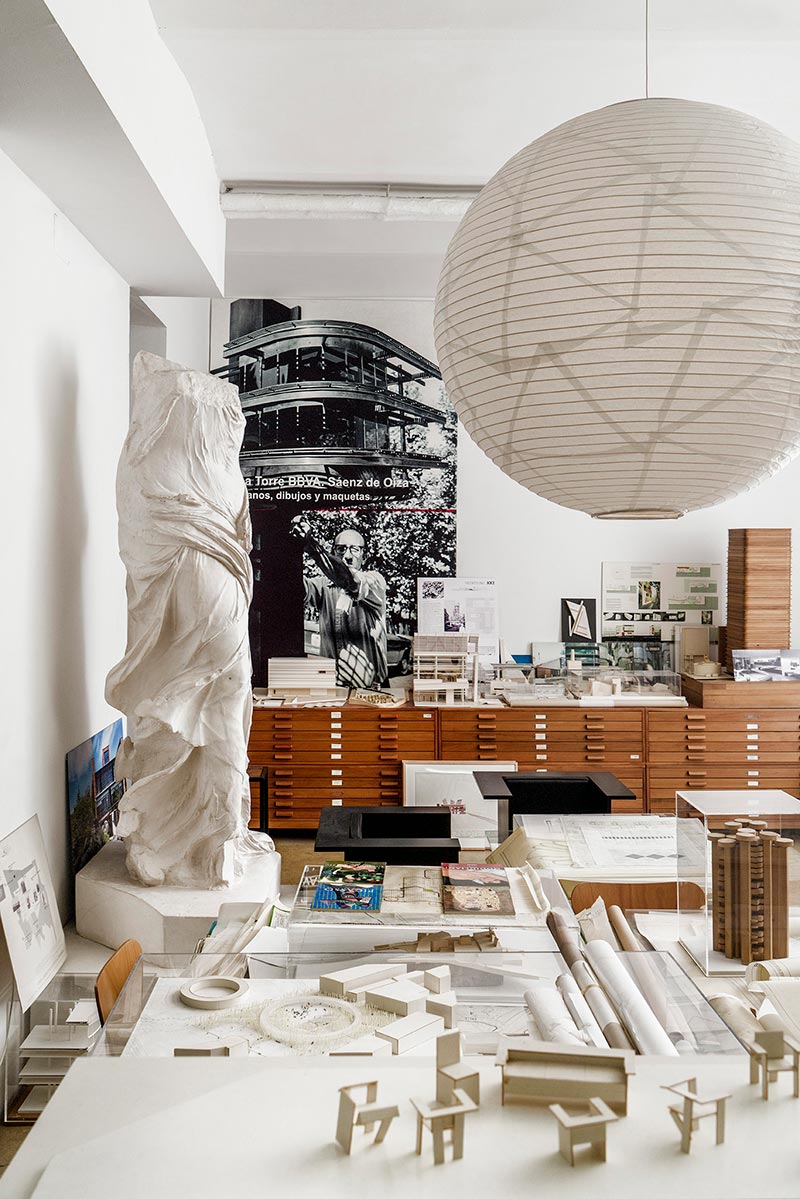
‘Sáenz de Oíza. Artes y Oficios’ at Madrid’s Museo ICO explores de Oiza’s projects through the lens of his relationships with artisans and craftspeople. The exhibition was part of the Madrid Design Week program and runs until the 26th of April 2020.
WORDS Tili Amelia Bensley-Nettheim
PHOTOGRAPHY Museo ICO, Ana Amado, Boluddha
CASE STUDY
— DISSONANT BEAUTY
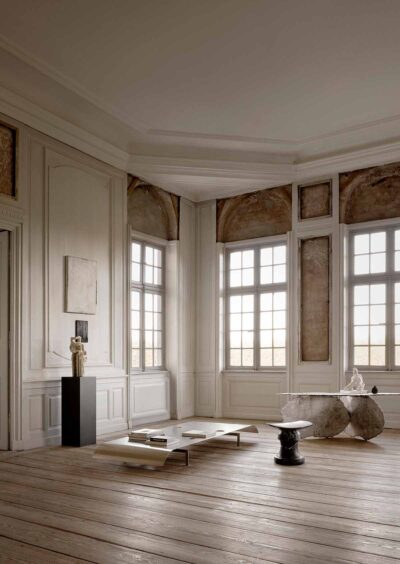
As in music, interior design calls on many elements – rhythm, contrast, repetition – to create that most subjective of visions: beauty.

DESIGN MUMBAI
India’s creativity, natural resources, extensive skills, technological advancements and deep historical roots deserve wider recognition and appreciation.
CINCINATTI MODERN
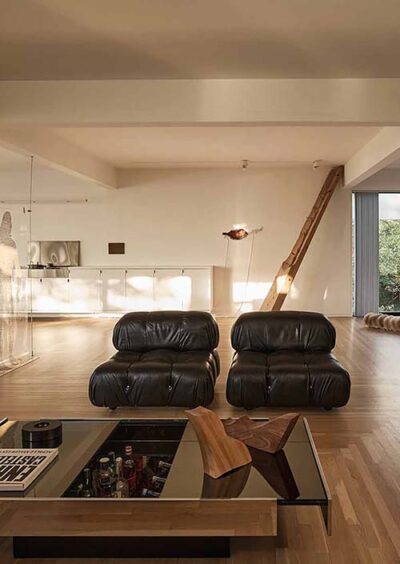
High on a hillside in Cincinnati, sits a two-storey modernist wonder by two unsung heroes of American architecture, built for an art collector in the 1980s and that has been given a sensitive makeover to accommodate the collection of its second owner.
FRANCISCO JAVIER SÁENZ DE OIZA’S TORRES BLANCAS
ARCHITECTURE
A RETROSPECTIVE AT MADRID’S MUSEO ICO CELEBRATES THE ICONOCLASM OF SPANISH ARCHITECT FRANCISCO JAVIER SÁENZ DE OIZA (1918 – 2000), RETURNING ATTENTION TO HIS 1960S MASTERPIECE OF SPANISH ORGANICISM, THE TORRES BLANCAS.
Navarra-born, Francisco Javier Sáenz De Oiza is regarded as one of the most prolific Spanish architects of the twentieth century. In the 1950s, following an unimaginative return to the neo-classical style under Generalissimo Franco, Oiza, with peers Francisco de Asis Cabrero, and Miguel Fisac, began integrating international architectural vernaculars in their search for a Spanish Modernism.
Oiza, who spoke of being, “born in the middle-ages and living in the avant-garde of the twentieth century”, initially practiced a rational geometric modernism before moving towards a rebellious organicism style exemplified in his social housing projects in Madrid. The Spanish Modern Movement that consolidated itself sprung from this contradiction; embracing a true modern architecture and simultaneously participating in an exaggerated organic revisionism. This was a style that sought to reconcile human-built structures with nature, the precision of Mies van der Rohe in communion with the naturalness of Frank Lloyd Wright.
The contradictions of the movement, as well Oiza’s singular syncretic talent, is exemplified by his Torres Blancas urban housing project commissioned by John Huarte in 1961 and completed in 1969. “Torres Blancas is a communion of the prairie homes of Frank Lloyd Wright, the Kingo Houses of Jørn Utzon and the power of Le Corbusier” says Oiza’s son Javier Sáenz Guerra, of his father’s masterpiece. A centrepiece of Madrid’s skyline, Torres Blancas appears as a vertical-garden growing upward 71-metres. The volume of the cast-in-place concrete tower is created by a cylindrical structure that is integrated with smaller curvilinear forms and surrounded by curved balconies. These secondary structures zag asymmetrically from side-to-side and are grouped in a manner akin to that of leaves on branches. The structural typology of the cylinders cluster at the top and expand in diameter to house the apartment’s communal facilities including the rooftop pool.
The apartment building remains the exclamation point of Madrid’s skyline, a bubbling and biology-like lighthouse and much sought after residence for the city’s social elite. “Torres Blancas relates to the image of a castle, as a place of protection,” says Guerra. “It holds an important place in Madrid as a symbol, as part of a myth.”
‘Sáenz de Oíza. Artes y Oficios’ at Madrid’s Museo ICO explores de Oiza’s projects through the lens of his relationships with artisans and craftspeople. The exhibition was part of the Madrid Design Week program and runs until the 26th of April 2020.
WORDS Tili Amelia Bensley-Nettheim
PHOTOGRAPHY Museo ICO, Ana Amado, Boluddha